History of the Davis Senior High School Baroque Ensemble’s Development
The Creation of the First US Public High School Baroque Ensemble.............
At present the DHS Orchestra Program has grown four times its original size in the past 20 years since the hiring of Angelo Moreno in 2000, Director of Orchestras at Davis Senior High School. By 2008 the program had developed into 2 groups the “DHS Chamber Orchestra” a non-auditioned string orchestra including violin, viola, cello, Bass, at 55 students, and the “DHS Symphony Orchestra” an auditioned full symphonic orchestra including woodwind, brass, percussion, and stringed instruments, at 75 students-making a total of 130 students between two groups. The growth at the High School has contributed to the growth at the elementary school and junior high level music programs and the positive continuation rate of orchestra students from 7th grade to 12th grade. As the two orchestras continued to grow there came the need for a third orchestral ensemble. Like a Jazz band for a band program or a Madrigal Choir for a choral program the DHS Baroque Ensemble became a natural extension of the DHS Orchestra Program as well as the second audition orchestra at DHS. This group provides students the opportunity to focus on Baroque music, Baroque performance practices, and master technique skills on period style instruments in a smaller ensemble. The period style instruments allow the unique style of the era to be further developed making the overall performance experience more historically accurate and engaging for the student musicians. The DHSBE also allows orchestral students the ability to access a rich and diverse wealth of orchestral literature unique to the development of music as we know it today, which was not possible within the organization of the orchestra program prior to the creation of the group.
The DHS Baroque Ensemble was featured in several national publications including “Symphony Magazine-Online”, “Early Music Magazine”, “Strings Magazine”, “Teaching Music Magazine”, and the “California Music Educators Association-Online”, for its unique nature and the model it represents for what is possible in the development of other public music programs since the DHS Baroque Ensemble is the first group of its kind at the High School level in the USA.
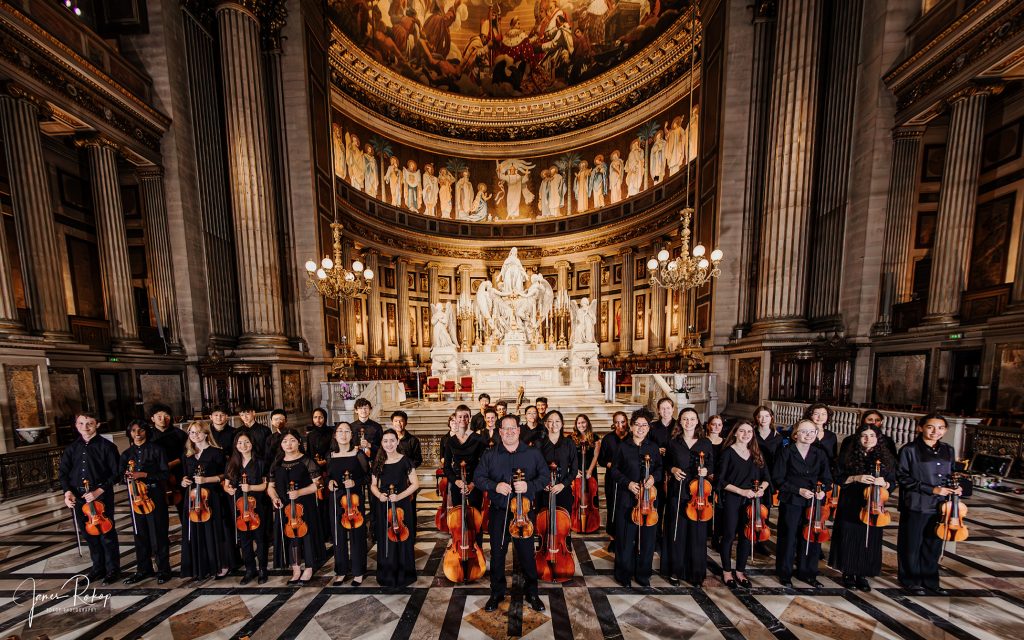
Without the support of the school administration, district administrators, and the school board this new course would not have been possible. The district supported the course by passing the course proposal unanimously and allowing the DHS Music Department to implement the DHS Baroque Ensemble into the DHS Orchestra Program. Unfortunately, there were no grants or monetary support from the district beyond teacher FTE. It costs about $12,000 to convert all the instruments and purchase the Baroque Bows for 20 violins, 6 violas, 6 cellos, and two basses. Doing half conversions saved us from having to purchase all new instruments. I used the best instruments in the school district collection that had been donated over many years. The half conversion included: removing the chin rests, adding baroque tailpieces, baroque bridges, adding gut strings to all the instruments, and purchasing new music specifically for this ensemble. I also added Precision Tuners to all the instruments because gut strings must be tuned frequently. I found that the students had a hard time getting perfectly in tune with the regular peg tuners. The precision tuners have made a world of difference. The money came from the parents and the many community donations made to our Orchestra Boosters over the years. Our Booster group financially allowed this new group to start off well equipped with period style instruments including a professional level John Phillips (1991) Harpsichord and style appropriate music. We have since acquired a wonderful Baroque Chamber Organ, which adds to the diversity of our continuo sound. The orchestra students earned the creation of this course and sealed the commitment of the School District with their continuously climbing enrollment numbers, commitment to the program, and love for playing orchestral music.
It should be noted that the DHSBE has received vital support from the UCD Music department and was inspired by UCD Baroque Ensemble Directors Phebe Craig and Michael Sand, musical mentors of Angelo Moreno. Routinely Phebe Craig generously shares her harpsichord expertise by coming to DHS to coach the harpsichord students individually and within the group rehearsal. The group is also privileged to have had Richard Webb, former member of the Academy of Ancient Music, as a continuo coach for lower strings. Richard is also a wonderful artistic consultant and resource as well as group dynamics coach.
The group has collaborated with the UCD Baroque Ensemble directed by Michael Sand and Phebe Craig, the CSUS Camerata Capistrano Directed by Lorna Peters, UC Berkeley Baroque Ensemble Director Davitt Moroney, Philharmonia Baroque Orchestra members Carla Moore, Mia Silverstein, Robert Howard, Elizabeth Blumenstock and American Bach Soloists member Katherine Heater. Most notably in 2014, 2017, 2022 the DHSBE was honored to have Rachel Barton Pine as our guest soloist. We presented our Virtual Baroque video performance featuring Rachel Barton Pine and her daughter Sylvia Pine in June 2020. The DHS Baroque Ensemble made its debut on the main stage at the 2014 Berkeley Baroque Festival and is proud and honored to have been invited back to the main stage in 2017 and again in 2020 EMA Virtual Baroque Festival.
In June of 2017 the DHSBE accomplished its second major international tour, the first one being in 2014 to Italy for 10 days. The 2017 tour was 14 days starting in Vienna and ending in Italy. The group performed in historically significant Baroque Cathedrals major cities including Vienna, Eisenstadt, Salzburg, Wattens, Innsbruck, Venice, Padua, Cremona, Lucca, Montecatini, Florence, and Rome. The group had planned to return to Europe in June 2020 for a 14-day tour to England, Belgium, and France.
Due to the Covid-19 pandemic, travel bands, and school closures our much-anticipated European tour was unfortunately canceled. We are so thankful to all our supporters for their contributions and well wishes. The students were devastated during this time of separation from one another and the loss of all they had worked toward in 2020, but they were strong and resilient and came back to the concert stage better than ever in 2021-22 and were able to return to Europe to share our music once again with all of our European friends in England, Belgium, France! We look forward to our next tour to Spain in June 2026 where we can once again enjoy working to achieve new musical heights and perform in some of the most beautiful venues in the world.
How the DHSBE Acquired our John Phillips Harpsichord:
Angelo Moreno had been in the process of locating a Harpsichord for 1.5 years even prior to the group’s initial existence. The instrument was found in San Jose, California USA at the St Joseph’s Cathedral just by chance. Mr. Moreno was in the church performing with his daughters Giavanna (violin) and Dchenin Moreno (cello) in a trio at a family wedding and he just so happened to spot three harpsichords covered up in the back of the room. After investigating with the Church Director, he found out that these instruments were donated and that the church wanted to sell them to raise funds for a concert series. Since the church director knew Mr. Moreno was a director of a public-school orchestra program and that the instrument was going to be used to educate young musicians, she was very generous with her final offer. Mr. Moreno had Larry Snyder and Phebe Craig, both harpsichord experts in Davis, California and friends of the DHS Orchestra Program assist him every step of the way. They advised him on all the instrument details as well as confirmed for him that he had found the best instrument and price possible on the open market.
An alumni donor from the DHS Orchestra Program helped to offset the price of the instrument considerably. This donor contacted Mr. Moreno out of the blue one day 4 months prior to the group’s existence and shared with him that she was interested in donating a harpsichord to the DHS Orchestra Program in memory of her mother who just passed away. Her mother was a former music teacher and lover of harpsichord music and listened to harpsichord in her final days to comfort her. He shared with her the coincidence and perfect timing of her contacting him and that he was the only high school director in the country that would need a harpsichord since the DHS Baroque Ensemble was to be the first one of its kind at the high school level in the country.
The Instrument we obtained was built by John Phillips in 1991 in Berkeley. The instrument is called #44 which indicates the order in which he builds them. It was made origi - nally made for Joseph Faria and was kept at Mission San Jose. The original owner, who has since passed away, was an attorney named Joeseph Faria. Joseph was a collector of fine instruments and in the late ‘80’s purchased many fine instruments from local makers which eventually were donated to Mission San Jose. It is a Ruckers-Taskin model, based on the 1646 Andreas Ruckers, rebuilt by Pascal Taskin in 1780 which is in the Musée Instrumental at the Cité de la Musique in Paris. John Phillips has built around 35 of them, and they have become his most popular model. The UCD music department also has one, built in 1990. The DHS Harpsichord in - cludes a fourth register in soft leather (peau de buffle) which is present on the original, but only rarely on the copies. All the decorations on the inside of the instrument and including the lid cover (which is a mural that depicts the Resurrection of Christ) was done by John Phillips longtime assistant artist, Janine Johnson. The instrument cost brand new has been estimated at over $49,000, final purchase price was $10,000, plus the private alumni donor paid $6,000 making the total cost to the DHS Orchestra Program only $4,000!!! In speaking with the maker John Phillips confirmed that it is very rare for people who own this level of an instrument to resell them and even more impossible to get one at 90 % off its value. In the end it is an incredible story of many wonderfully knowledgeable and supportive people coming together and through their generosity helping to find the most perfect instrument for many generations of Baroque students to enjoy at DHS.
Director Info